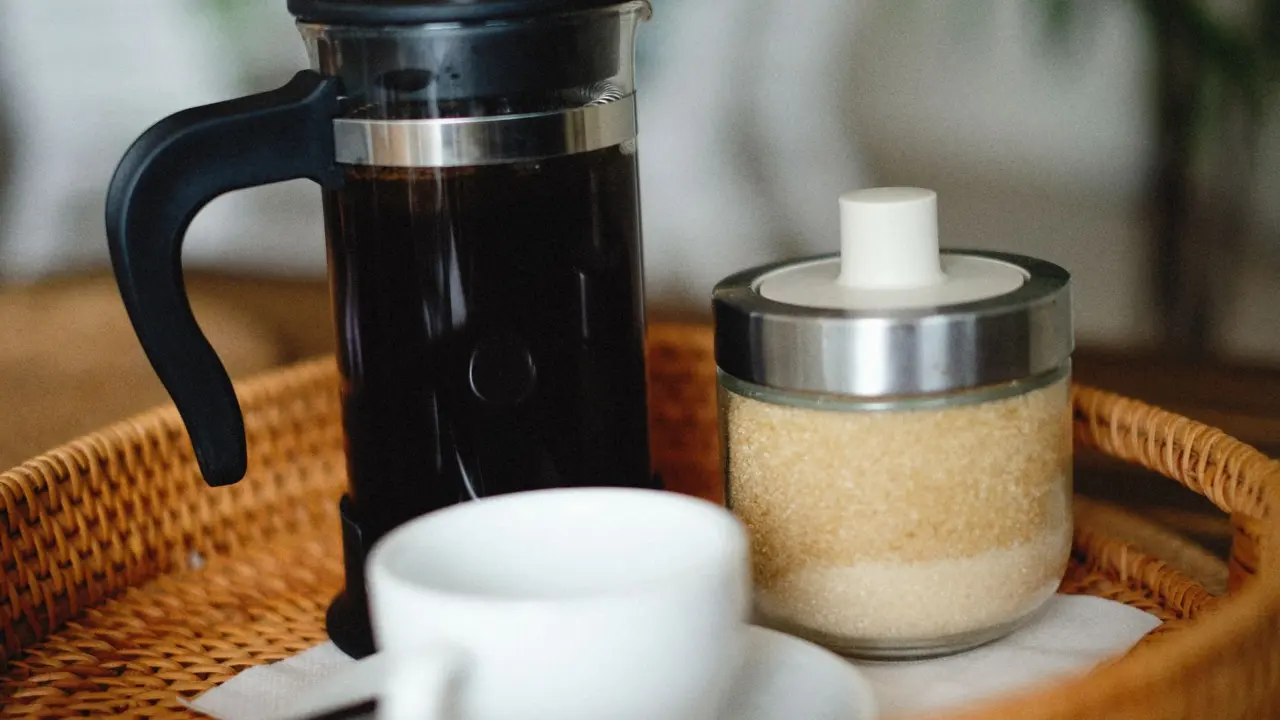
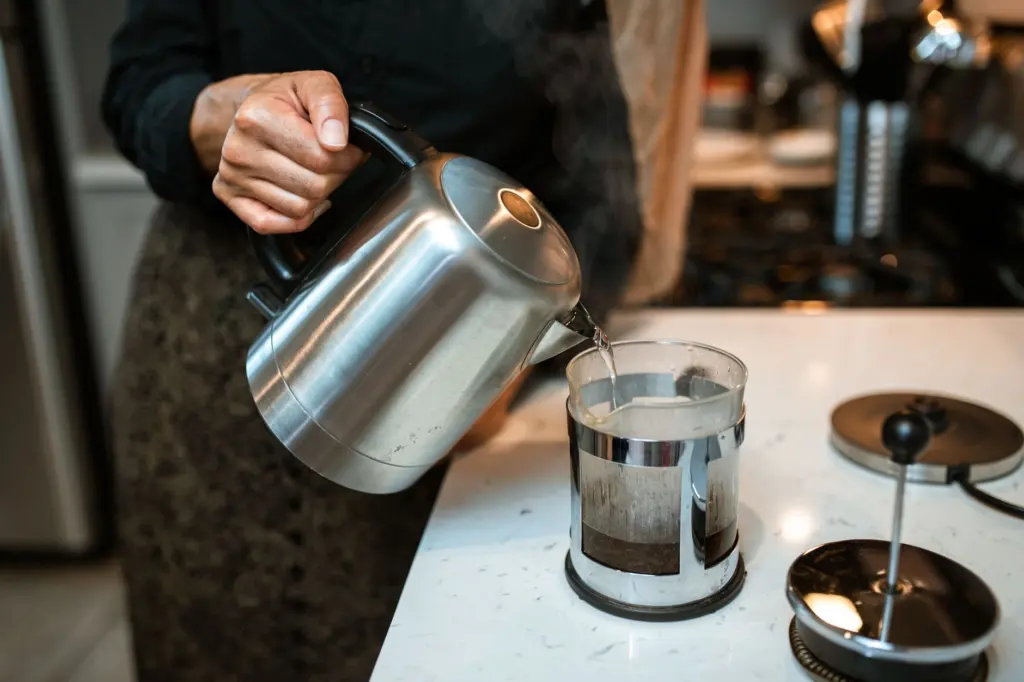
Here is how to use French press brewing: add coarse grounds, pour hot water just off the boil, let the coffee steep, then press the plunger down slowly. The key condition is a coarse grind, because the grounds stay in the water throughout.
This method is one approach within how to brew coffee at home, and it suits anyone who wants a full-bodied cup without a paper filter or special equipment beyond a kettle and a timer.
Why the press rewards coarse grounds and patience
A French press is a full-immersion brewer: Starbucks at Home’s coffee press guide notes that the grounds are immersed for the entire brew. That one fact explains most of the technique. Time in the water, water temperature and grind size all keep acting on the coffee until you press the plunger, so they are the settings that decide the result.
Grind size matters most. The same guide recommends a coarse grind to produce a rich flavour without bitterness, and a French press maker’s guide on brewing in a French press adds that a coarse grind is essential to prevent a bitter brew and a clogged filter. For a visual cue, Little Sunny Kitchen suggests grinding until the beans resemble coarse sand. If you grind at home, set the grinder to its coarsest range before you start. Our guide to Coffee Grind Size: The Simple Guide To Better Flavor In 2026 – Greatnorthernbrewing explains how grind settings change a cup.
The plunger and its filter do one job: they separate the brewed coffee from the grounds when you press them down slowly. A press does not control extraction while the coffee is brewing, so get the ratio, temperature and timing right before the water goes in.
Ratio, temperature and timing at a glance
| Variable | Value | Planning use |
|---|---|---|
| Coffee to water | 10 g coarse grounds per 180 ml (2 tbsp per 6 fl oz) of water | A practical starting dose when you have no scale. |
| Ratio range by weight | About 1:15 to 1:17 coffee to water | Move toward 1:15 for a stronger cup and toward 1:17 for a lighter one. |
| Water temperature | 90–96 °C (195–205 °F) | Aim for the middle of the range if you have a thermometer. |
| Rest after boiling | About 30 seconds off the boil | A thermometer-free way to bring boiled water into range. |
| Bloom | 30–45 seconds after pouring about twice the coffee’s weight in water | Start the timer when the water first touches the grounds. |
| Stirring | One or two gentle stirs | Enough to wet all the grounds; more is unnecessary. |
| Steep | About 4 minutes before plunging | The default; adjust it by taste on later brews. |
These figures come from Starbucks at Home’s press guide and a grinder brand’s step-by-step French press guide.
Other published ratios fall in the same territory. Good Housekeeping recommends 1:16 coffee to water, which sits inside that range, so pick one ratio and keep it constant while you tune everything else. Changing one variable per brew tells you which change fixed or spoiled the cup.
Bloom, pour and steep
The bloom is the short pause after the first pour that lets the wetted grounds settle before the main pour. Gundog Grind’s guide lets the coffee bloom for 30–45 seconds, and the French press maker’s guide gives about 30 seconds. Either works, so choose the longer end if the coffee tastes sharp and the shorter end if it tastes heavy.
- Grind and measure. Grind the beans to a coarse, sandy texture and add them to the empty press using your chosen ratio.
- Heat the water. Bring the water to the boil, then let it stand about 30 seconds. Good Housekeeping puts the ideal at about 200 °F and notes that boiling water is 212 °F, so water straight from the kettle is hotter than you want.
- Bloom the grounds. Pour in about twice the coffee’s weight in water, making sure all the grounds are wet, and wait for the bloom.
- Add the rest of the water. Pour in the remainder and give the mixture one or two gentle stirs. Little Sunny Kitchen likewise advises a brief stir before the lid goes on.
- Steep. Set the timer for about 4 minutes. Good Housekeeping describes grounds floating to the top after one minute and forming a crust, then breaking it with a stir and steeping three more minutes with the plunger raised.
The steep time is where personal taste enters. Little Sunny Kitchen calls about 4 minutes the sweet spot, with 3 minutes giving a lighter cup and 5 minutes a stronger one. The French press maker’s guide gives a 3–5 minute window. Start at 4 minutes, then change by a small step on the next brew.
Plunge and serve
Press the plunger down slowly and steadily; Starbucks at Home describes separating the coffee from the grounds by pressing slowly. Good Housekeeping advises pushing the plunger gently all the way down and serving immediately. A hurried push can make the press harder to control and is a sign the grind may be wrong.
Serve straight away rather than leaving the press on the counter. The coffee is only separated from the grounds at the point you plunge, so the cup is at its best when you pour it promptly. If you enjoy French press coffee, the range of cups in Different Coffee Drinks: The Practical Guide To 2026’s Most Popular Cups – Greatnorthernbrewing shows where a strong, full-bodied brew like this fits among other drinks.
Fixing common problems
Most French press faults trace back to grind size or timing, so check those first.
- Hard to press. According to Gundog Grind, a plunger that resists suggests the grind is too fine. Coarsen the grind for the next brew, since a fine grind is also what clogs the filter.
- Plunges too easily. The same guide points to a grind that is too coarse when the plunger drops with almost no resistance, which usually means a weak cup. Go slightly finer and keep the ratio unchanged.
- Bitter or harsh. Coarsen the grind first, since a coarse grind is recommended to avoid bitterness. Then shorten the steep toward the 3-minute end of the range.
- Weak or thin. Lengthen the steep toward 5 minutes or use a ratio nearer 1:15 rather than changing several things at once.
Water temperature belongs on the checklist too. Keep it inside 195–205 °F; for a middle-of-the-range target, Little Sunny Kitchen’s ideal of 195 °F (90 °C) and the French press maker’s roughly 200 °F (93 °C) both fall within that band.
Cleaning the press
Clean the press after every brew. Starbucks at Home stresses cleaning grounds stuck in the filter after every use, because the filter is where residue collects. Little Sunny Kitchen suggests removing the grounds from the bottom of the carafe with a plastic spoon or your hands, then washing with hot soapy water. A plastic spoon avoids scratching the glass.
For a thorough clean, Good Housekeeping advises disassembling the nested filter so you can scrub off deposits and residual oils. Rinse everything well and let the parts dry before reassembling.
Frequently asked questions
How long should I steep French press coffee?
A 3–5 minute window is typical, and 4 minutes is the usual starting point. Shorten the steep for a lighter cup and lengthen it for a stronger one.
What if I do not have a scale?
Use tablespoons. Little Sunny Kitchen suggests 1 rounded tablespoon of coarsely ground coffee per 1 cup (8 oz) of water, while Starbucks at Home and the French press maker’s guide use 2 tablespoons per 6 fl oz.
Is water straight from the kettle too hot?
Yes, if it has just boiled. Boiling water is 212 °F, above the 195–205 °F range recommended for the press, so rest the water for about 30 seconds first.