A French press cup that tastes thin or bitter can point to the french press coffee to water ratio. Start at 1:15 by weight, which is 1 g of coffee to 15 g of water, then adjust by taste.
That starting point comes from a French press maker’s ratio guide. It is one part of the wider routine in our guide on how to brew coffee at home. This page stays on the ratio, the measurements for each batch size, and the few variables that change how that ratio tastes.
Ratio misconceptions that spoil the cup
The standard French press ratio is 1:15 by weight, meaning 1 gram of coffee for every 15 grams of water. Most bad cups come from treating that figure, or the tools used to hit it, as more rigid or more forgiving than they are. The table sets three common beliefs against what the evidence supports.
| Common belief | What holds up | Planning use |
|---|---|---|
| A tablespoon is not always the same amount | A level tablespoon of coarse coffee can vary in weight as roast and grind change. A kitchen scale gives the most consistent results. | Weigh the coffee. Keep spoons as a rough fallback only. |
| 1:15 is a fixed rule | 1:15 is the standard. Try 1:14 if the cup tastes weak, and back off to 1:16 if it tastes too strong or bitter. | Brew the first batch at 1:15, then move one step toward 1:14 or 1:16. |
| Grind size is the first dial to turn | French press uses a coarse grind. Set the ratio first, then dial in grind size based on taste. | Fix strength with the ratio before touching the grinder. |
Figures are from a French press maker’s ratio guide and a French press brewing guide.
The 1:14 to 1:16 range is a gentle adjustment around the standard. That is why changing the ratio in small steps is a better response to a disappointing cup than overhauling the whole recipe.
Exact measurements by batch size
Batch size is easiest to plan by water weight, because “cup” means different volumes from one press to another. One brewing guide’s chart lists a 4-cup press at 500 ml, while a French press maker’s guide pairs a 4-cup press with 900 ml. Match the row to the water your carafe actually holds, not to the number printed on the box.
The brewing guide’s chart gives these doses, with the tablespoon figures as a fallback if no scale is available:
- One mug (8 oz / 240 ml): 16 g coffee to 240 g water, about 3 level tablespoons.
- 3-cup (350 ml): 23 g coffee to 350 g water, about 4.5 tablespoons.
- 4-cup (500 ml): 33 g coffee to 500 g water, about 6.5 tablespoons.
- 8-cup (1 litre): 67 g coffee to 1000 g water, about 13 tablespoons.
- 12-cup (1.5 litre): 100 g coffee to 1500 g water, about 20 tablespoons.
The maker’s guide supplies two larger-press examples: 30 g of coffee per 450 ml of water for a 2-cup press, and 60 g per 900 ml for a 4-cup press. Both are useful if your press is sized that way. Use whichever chart matches your carafe, and do not mix doses from one chart with water amounts from another.
Weight versus volume
Weight is the better unit for a French press ratio, because a kitchen scale gives the most consistent results. Water makes this easy. One millilitre of water weighs exactly one gram, so water can be poured to a gram target on the same scale that weighed the coffee. That is also why the batch chart above lists water in grams.
Volume still works as a fallback. The maker’s guide gives the volume form of the ratio as 2 tablespoons of coffee per 180 ml (6 oz) of water. Treat it as an approximation. Because a tablespoon of coarse coffee can weigh differently by roast and grind, two cups made with the same scoops may not taste the same.
- Suits a scale owner: weigh both coffee and water in grams and test small ratio changes such as 1:14 against 1:15 with confidence that only the ratio moved.
- Suits a spoon user: level the spoon every time, keep the same coffee and grind setting, and move to a scale once the routine is settled.
Grind, water temperature and brew time
The ratio sets how much coffee meets the water, and three other variables decide how much flavour that coffee gives up. Keeping them steady is what lets a ratio change show up clearly in the cup.
Grind size
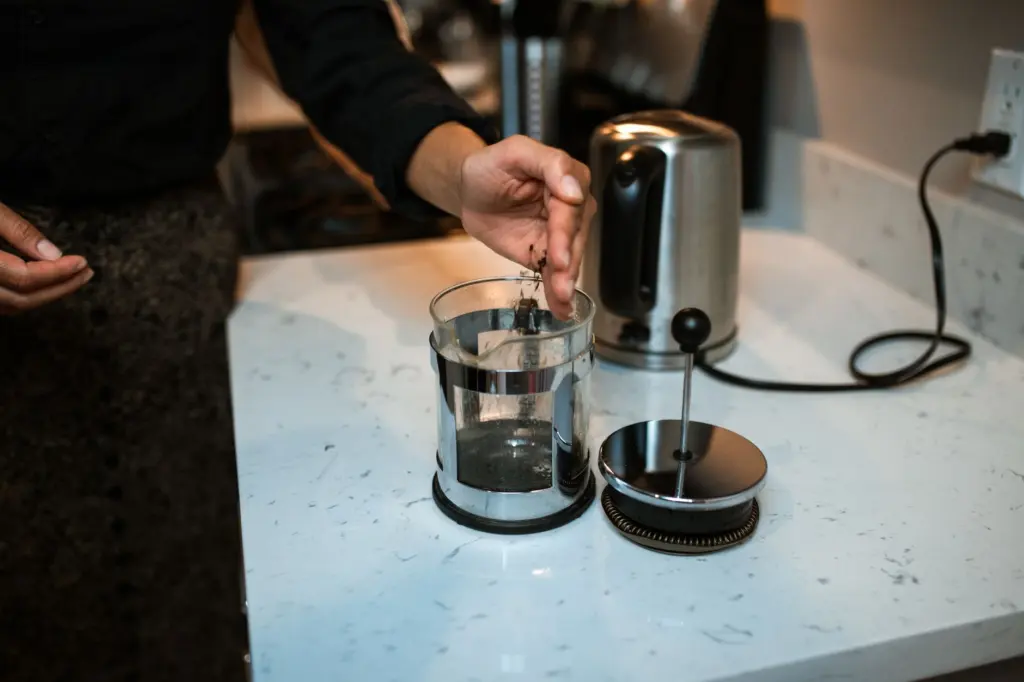
French press uses a coarse grind, and the picture to hold in mind is rough sea salt. For immersion brewing, a very chunky, coarse grind is the target. If the grounds look like fine powder, the grinder setting is wrong for this brewer, whatever the ratio.
Water temperature
The sweet spot is 90 to 96 °C (195 to 205 °F). Water at a full 100 °C can scorch the grounds and push out bitter notes. If the kettle has just boiled, give it a short pause before pouring.
Steep time
A steep of 4 minutes is the standard. A coarse grind extracts more slowly, which is why French press brews for 4 minutes rather than the 30 seconds of espresso. If you want that short, concentrated extraction instead, our guide to Pull Perfect Espresso Shots At Home: The Practical 2026 Guide To Consistent, Café‑Quality Results – Greatnorthernbrewing covers it. A recipe that adds a pre-infusion step totals 4 minutes 30 seconds.
Brewing sequence
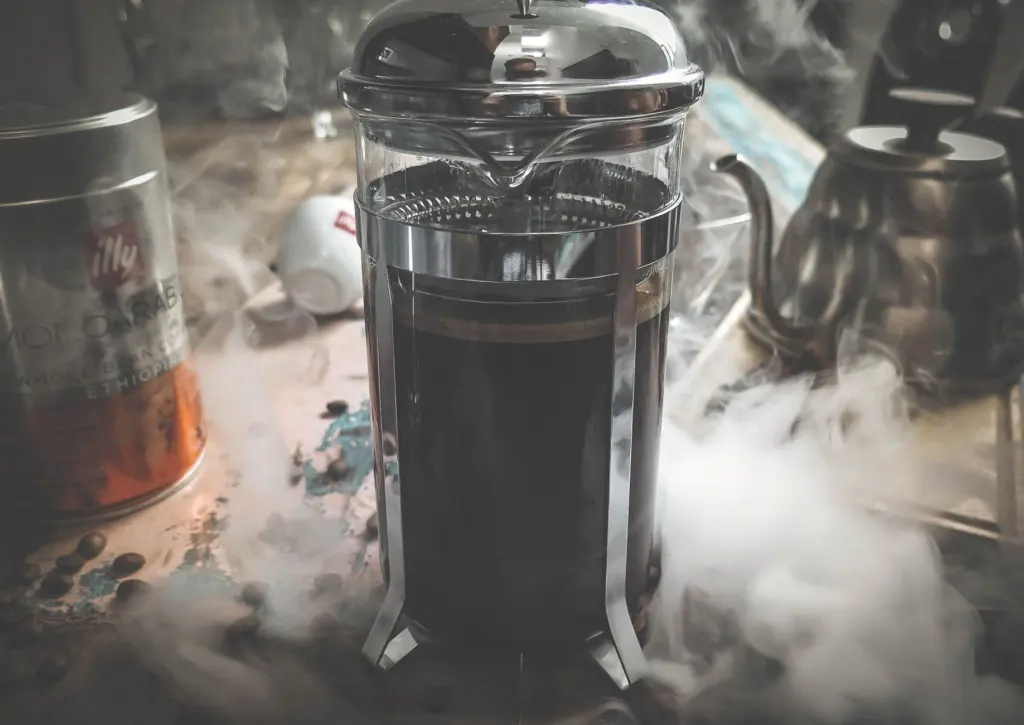
The sequence below is the simplest way to apply the ratio. It uses only the settings covered above.
- Weigh the coffee on the scale, using the dose from the batch list for your press, and grind it coarse.
- Heat the water to the 90 to 96 °C range described earlier.
- Pour water to the target weight with the press still on the scale, so the coffee-to-water ratio is exact.
- Start the timer for the 4-minute steep.
- Press the plunger down once the timer ends.
Making the cup stronger or milder
Change the ratio in small steps and taste each result before changing anything else. This is the most direct answer to making French press coffee stronger.
- Stronger: use more coffee for the same water. The maker’s guide suggests trying a 1:14 ratio and tasting the difference. That suits a cup that is acceptable but light.
- Milder or less bitter: if it tastes too strong or bitter, back off to 1:16 with the same grind, temperature and steep time.
- Deliberately heavy: one guide uses 60 g of coffee and 800 g of water, about 1:13.3. Try that only if a small increase in coffee still leaves the cup tasting light, since it uses more coffee than the standard dose.
Roast level is a separate lever from the ratio. If a cup disappoints even at a sensible ratio, our comparison Light Roast vs Dark Roast: A Practical Guide To Flavor, Caffeine, And Brewing In 2026 – Greatnorthernbrewing is the next place to look.
Frequently asked questions
| Question | Answer |
|---|---|
| How much coffee does one litre of water need? | One trade recipe uses 65 g of coarsely ground coffee per 1,000 ml of water (2.5 oz per 35 oz). Weigh the water for the best match. |
| What if the finished cup is too strong? | You can add a little water to the finished cup rather than discarding it, then lower the coffee dose on the next brew. |
| How can I tell the ratio has too much water? | With too much water, the coffee will taste thin and watery, lacking a full body. Add a little more coffee and taste again. |