| Decision | Supported value | Planning use |
|---|---|---|
| Single glass | 2 tsp loose-leaf blend per 8 oz serving, over 1/2 cup boiling water, steeped 3-5 minutes | Scale this per glass when you only want one or two drinks. |
| Sweetness and dairy per glass | 1 tsp sugar and 2 tbsp dairy per serving | A starting point to adjust at the glass, not a fixed rule. |
| Batch base | 3/4 C leaves (about 3 oz) with 6 C boiling water, steeped 5 minutes, makes 6 glasses; or 3/4 cup leaves with 4 cups hot water, steeped 5 minutes | The smaller water volume gives a stronger base that milk and ice can dilute. |
| Colour | Orange in commercial Thai tea is artificial; a natural blend brews light brown | Expect a brown drink unless you deliberately add colour. |
| Dairy-free route | Coconut milk, or about 1/3 to 1/2 cup oat milk per serving | Both give a vegan-friendly glass; the quantities differ. |
| Cooling | Cool slowly to room temperature before refrigerating | Avoids clouding from chilling the tea too fast. |
Figures come from Arbor Teas’ Thai iced tea guide and Hot Thai Kitchen’s Thai iced tea recipe.
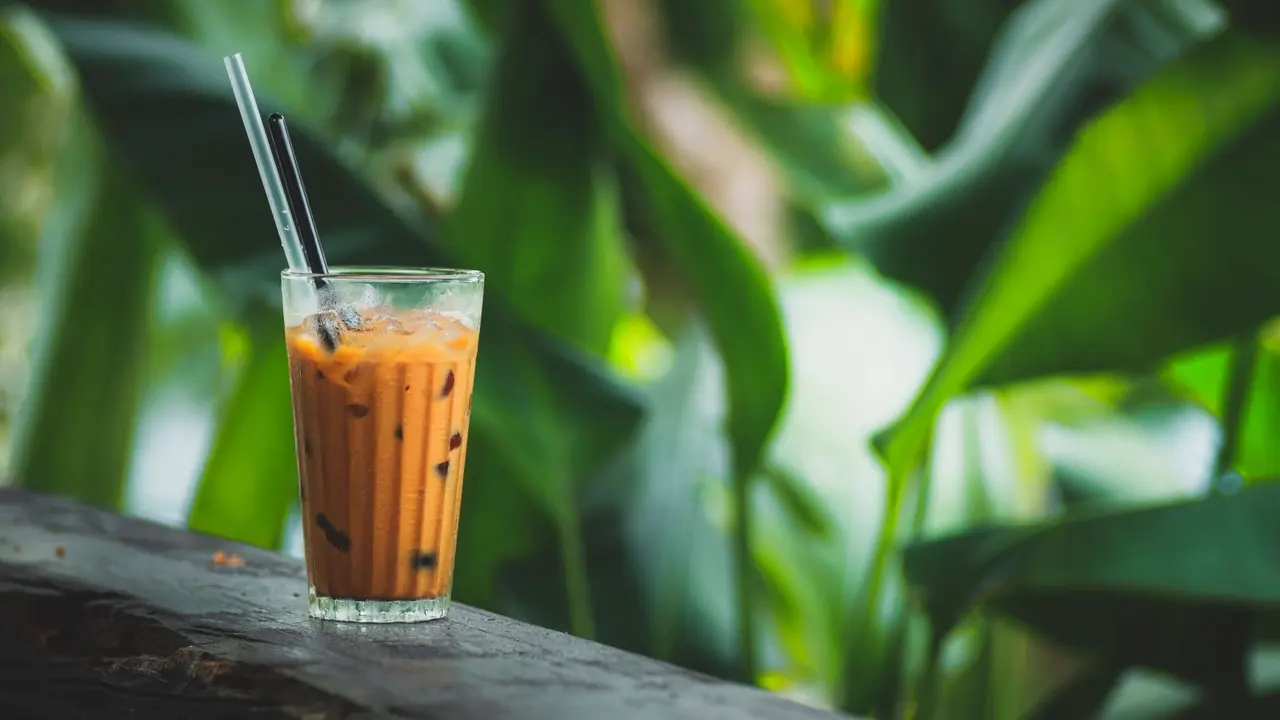
This recipe for Thai tea brews strong black tea, sweetens it while concentrated, and finishes with condensed and evaporated milk. The orange colour usually comes from added dye, so a natural brew looks light brown.
Leaf handling and steeping basics are covered in our guide on how to brew loose leaf tea.
Choosing your quantities
The quantity you start with depends on whether you are making one glass or a pitcher, and the two sources give noticeably different batch strengths.
One glass
Arbor Teas’ restaurant-style measure is 2 teaspoons of loose-leaf Thai tea blend for every 8 oz, brewed in 1/2 cup of boiling water. Add 1 tsp of sugar and 2 tbsp of dairy per serving. This suits anyone testing a new blend, because a single glass wastes little if the strength is off.
A batch for six
Arbor’s original recipe uses 3/4 C of black tea leaves (about 3 oz), 6 C of boiling water, 1/2 C of sugar, 1/2 C of sweetened condensed milk and 1 C of evaporated milk, and it makes 6 glasses. Hot Thai Kitchen puts the same 3/4 cup of leaves into 4 cups of hot water with 1/4 cup of sugar. Choose the smaller water volume if you like a pronounced tea flavour that survives plenty of ice and milk. Choose the larger one if you prefer a lighter drink.
Colour, flavour and what to expect in the glass
The bright orange of a street-style glass is mostly cosmetic. Arbor states that the orange in commercial Thai tea is created with artificial colouring, while its own blend brews a natural light brown. Hot Thai Kitchen is just as blunt that the iconic orange is orange food colouring, and White on Rice Couple notes that Thai tea mixes are normally dyed with yellow food colouring. The Forked Spoon adds that chefs added orange food colouring to early Westernised versions to give a bright orange hue.
What gives it the orange colour, then, is dye in the mix, not the tea or the milk. That leaves you three sensible choices:
- Accept the brown. A natural brew with milk tastes the same and suits anyone avoiding colouring.
- Add turmeric. Aimee Mars uses turmeric to get a burnt orange colour without food colouring.
- Buy a dyed mix. This gives the familiar look, but the colour is added and not a sign of better flavour.
For flavour, spices matter more than colour. The Forked Spoon describes Thai tea as infused with star anise and cloves, unlike plain black tea. Aimee Mars calls star anise a key ingredient, with a licorice-like flavour behind the bold taste. If you start from plain black tea, adding star anise is the single swap that moves the drink closest to the classic.
Steep time and bitterness
Steep time is the main control over strength, and it varies with the form of tea you use. Over-steeping plain tea costs you more than under-steeping it does, so begin at the short end.
- Loose black tea or blend, single glass. Arbor steeps for 3-5 minutes before removing the infuser.
- Batch of leaves. Both Arbor and Hot Thai Kitchen steep for 5 minutes. The Forked Spoon warns that steeping plain tea for more than 5 minutes can taste bitter.
- Premade Thai tea mix. The same source steeps a premade mix for about 15 minutes before straining, with a range up to 15-20 minutes, or boils it gently for about 2 minutes before removing it from the heat.
- From scratch with whole spices. Aimee Mars simmers the spices and tea for 3 to 5 minutes on low, then lets the tea cool completely, about 20 minutes, which also concentrates the flavour.
The practical rule is to follow the packet if you use a mix, since mixes tolerate longer steeping than plain tea, and to stay near 5 minutes if you use plain black tea.
Milk, sweetness and vegan swaps
Thai-style assembly combines the tea base with sweetened condensed milk and tops the glass with evaporated milk, as Hot Thai Kitchen describes it. Condensed milk supplies most of the sweetness and body, while evaporated milk adds a creamy finish without more sugar.
Yes, you can make it vegan, and you have three routes:
- Coconut milk. Arbor recommends coconut milk as the dairy-free milk, and Aimee Mars says canned coconut milk can replace both condensed and evaporated milk. It suits anyone who wants a rich glass with minimal changes.
- Oat milk. Hot Thai Kitchen suggests about 1/3 to 1/2 cup per serving. Expect a lighter, less syrupy drink than the dairy version.
- Coconut condensed milk, with a caution. In one test at Hot Thai Kitchen, the coconut fat congealed into little bits in the iced tea. If texture matters, use plain coconut milk and sweeten the tea instead.
Method for a batch of iced Thai tea
This method follows Arbor’s original quantities, which are the most complete single set in the verified sources.
- Measure. Use 3/4 C of black tea leaves (about 3 oz) and bring 6 C of water to a boil. Add any optional spices, such as star anise, to the leaves.
- Steep. Pour the boiling water over the leaves and spices for 5 minutes.
- Strain. Pass the tea through a fine strainer or cloth filter into a pitcher and discard the leaves.
- Sweeten. Stir in 1/2 C of sugar and 1/2 C of sweetened condensed milk to make the sweetened concentrate.
- Cool slowly. Let the pitcher reach room temperature before it goes into the refrigerator, because chilling tea too rapidly causes clouding.
- Serve. Fill glasses with ice, pour in the concentrate and top with evaporated milk, using 1 C across the batch, which makes 6 glasses.
Serving iced Thai tea
Topping the glass with evaporated milk, instead of stirring everything together, gives the two-tone look that Thai-style service is known for. Stir at the table if you want an even colour and flavour in every sip.

Related tea drinks
If you like the creamy, sweet profile here, The Perfect Milk Tea Recipe: How To Make Creamy, Bubble-Tea‑Style Milk Tea At Home (2026) – Greatnorthernbrewing takes it toward a bubble-tea style. For a tart, fermented alternative to a milky glass, see How To Make Perfect Kombucha At Home: A Simple Step-By-Step Recipe For Beginners (2026) – Greatnorthernbrewing.
Frequently asked questions
Is Thai tea just black tea?
Not quite. Hot Thai Kitchen describes the leaves as black tea, commonly Assam, with artificial flavour, most commonly vanilla. Plain black tea with star anise and cloves is the closest homemade version.
Can I make Thai tea ahead of time?
Yes. Arbor says you can make a large batch of the sweetened tea concentrate in advance and keep it refrigerated, then add dairy at the glass.
How does Thai style differ from American style?
According to Hot Thai Kitchen, Thai style uses condensed and evaporated milk, while American style uses sugar and half and half.
Can I make my own evaporated milk?
Yes. Aimee Mars simmers 1 cup of whole milk on low for 20 to 25 minutes.