| Choice | Supported value | Planning use |
|---|---|---|
| Hot cup | Steep covered for 15 to 20 minutes, off the heat | Right for drinking warm. Pour once the window ends, because a longer steep turns the petals bitter. |
| Same-day iced tea | Chill in the refrigerator for a couple of hours | Suits tea you want cold by later the same day. |
| Properly chilled iced tea | Refrigerate at least 4 hours, preferably overnight | Brew the evening before and serve over ice the next day. |
| Larger batch ratio | 1 cup dried hibiscus flower to 2 quarts water | A starting point for a full pitcher. Scale it up or down to the volume you need. |
| Smaller, honey-sweetened batch | 1/2 cup dried flowers, 8 cups water and 1/4 cup honey (serves 5) | A sweetened pot for a small group. Add more honey if you like the tea sweeter. |
The steep, chill and ratio figures above come from the hibiscus tea recipes published by My Food Story and Woodland Foods.
A good recipe for hibiscus tea uses dried flowers and boiling water, steeped covered for 15 to 20 minutes, then served warm or chilled over ice. Steeping longer turns the petals bitter.
Hibiscus is an herbal tea, so the timing and sweetening choices below differ from leaf teas. For general steeping habits across other teas, see how to brew loose leaf tea.
Hot or iced: what each choice means in practice
Hibiscus tea works either way. Culinary Hill describes it as a tart herbal tea you can serve hot or cold. The real decision is how much time you have, because the brewing is the same and only the finish changes.
- Serve it warm when you want a drink soon after brewing. The covered steep is the only wait, and you can sweeten each cup at the table.
- Chill it briefly when you need cold tea the same day. My Food Story suggests refrigerating the brewed tea for a couple of hours. This gives a cool drink, and it is not as thoroughly cold as an overnight batch.
- Chill it overnight when the tea is for guests or for several days of drinking. Woodland Foods recommends at least 4 hours and preferably overnight before serving over ice.
- Cold-steep it when you can plan ahead. Tea producer Tearora says to steep iced hibiscus tea for 8 to 12 hours before serving, which uses no stove at all.
So yes, you can serve hibiscus tea iced. The sections below cover the ratio first, then each method in turn.
Ingredients and ratios
You need dried hibiscus flowers, water and a sweetener. Lime is an optional extra for iced tea. Published ratios vary with batch size, so choose the one that matches how many people you are serving.
- Large pitcher for a crowd: Culinary Hill uses 1 1/2 cups dried hibiscus (about 2 1/2 oz) with 12 cups of water in total. That makes 12 servings of 8 oz each.
- Two-quart pitcher: Woodland Foods pairs 1 cup of hibiscus flower with 2 quarts of water.
- Small honey-sweetened pot: My Food Story uses 1/2 cup dried flowers with 8 cups of water and 1/4 cup honey, serving 5.
- Weighing by gram: Adventures in Foodieland uses 15 g of dried hibiscus to 2 L of filtered water for iced tea.
- Single cups: Tearora suggests 3 to 4 flowers for each cup of tea.
Measuring by volume and by weight are both workable. If you use cups, a kitchen scale is unnecessary. If you want repeatable batches, weigh the flowers once and note the figure for next time. Treat the first batch as a trial and change the flower quantity, not the steep time, when the tea tastes too weak or too sharp.
Hot method
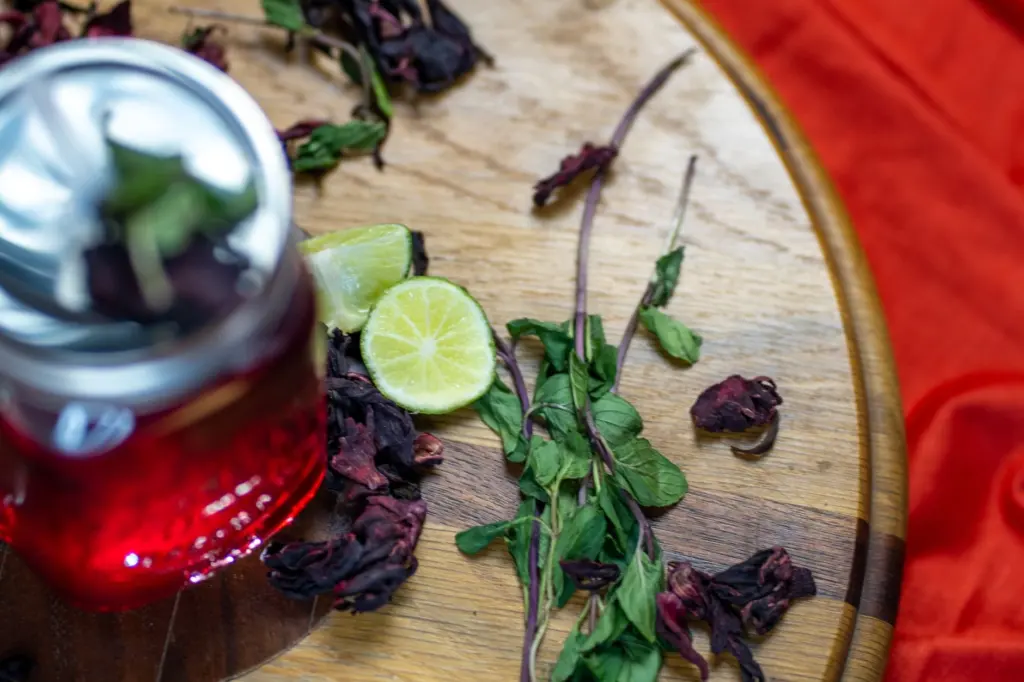
The hot method is the simplest route, and it needs only a heatproof pot or pitcher and a strainer. Dried flowers are used whole, so no trimming comes first.
- Measure the dried hibiscus into a heatproof pot or pitcher, using one of the ratios above.
- Pour boiling water over the flowers. Tearora describes the method as steeping dry petals in boiling hot water for several minutes.
- Cover the pot and steep. My Food Story gives 15 to 20 minutes, and Woodland Foods gives 20 minutes after adding the flowers to 1 cup of boiling water.
- Strain out the petals, then sweeten to taste while the tea is still warm.
If you prefer to use the stove, Culinary Hill simmers the flowers in 4 cups of water until they soften, about 15 minutes. It adds the remaining water afterwards to bring the batch to its full volume. This suits a large batch where you want the colour and flavour drawn out thoroughly. For a single cup, the covered steep is easier.
Iced method
Iced hibiscus tea follows one of three paths: a brewed-then-chilled batch, a concentrate, or a cold steep. Pick by how much time you have and how much fridge space you can spare.
- Brew, then chill: Make the hot tea as above, then refrigerate it. Woodland Foods suggests a minimum of 4 hours in the fridge, with overnight best, before serving over ice. This is the most dependable choice for a pitcher you will pour from repeatedly.
- Simmer, infuse and cool: Adventures in Foodieland simmers 15 g of dried hibiscus in water for 5 minutes, then infuses it for at least 15 minutes off the heat. It stirs in 120 g of honey and 2 tbsp of agave syrup, cools the tea in the fridge for about 1 hour, and finishes with lime juice. The method suits a 2 L pitcher with lime flavour built in.
- Concentrate: For a concentrate, Tearora says to place 3 cups of cold water on top of the flowers. Add 3 more cups before serving, for 6 cups in total. This keeps the strong flower base compact in the fridge, and you can dilute it to taste.
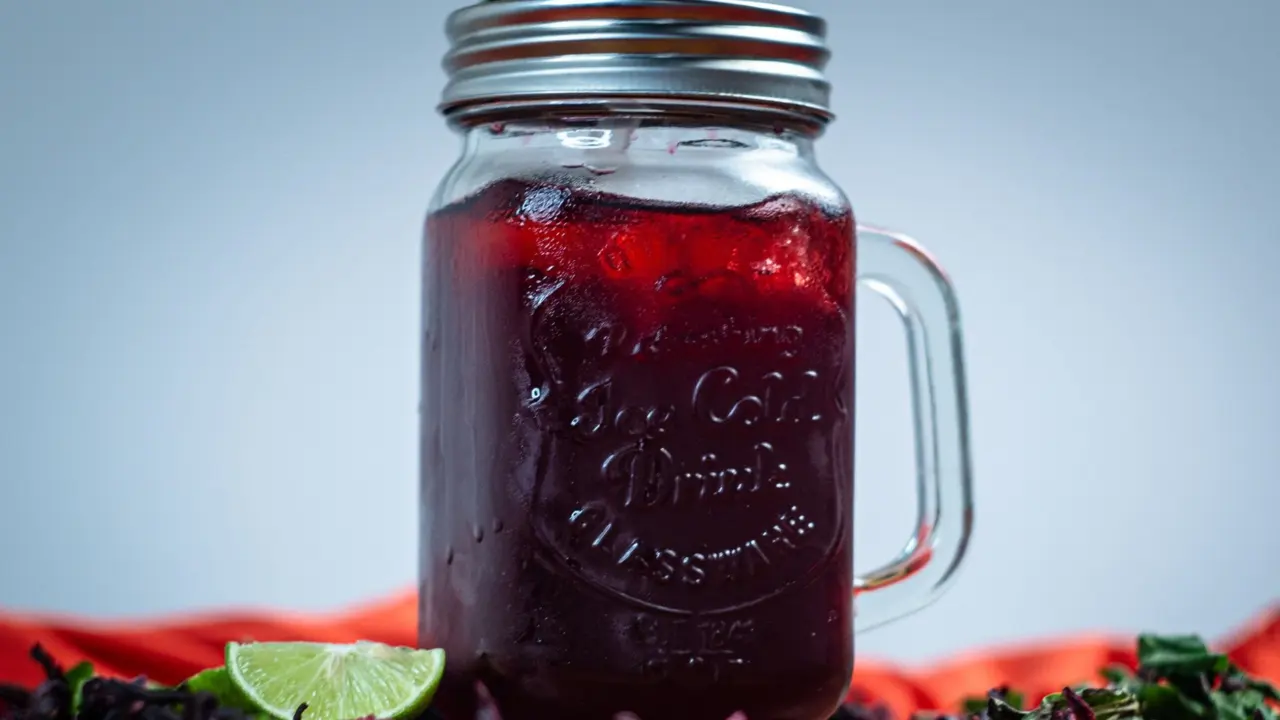
Serve the finished tea over ice. Culinary Hill adds lime wedges if you like. Lime suits the tart base, so it is worth adding for guests. Add the ice to the glass instead of the pitcher, so the batch does not water down as it sits.
Steep time and strength
Steep time controls how bitter the tea becomes. My Food Story warns against steeping the petals for too long because the tea turns bitter. The covered hot steep is therefore a window, and you should not treat it as a minimum to exceed.
Woodland Foods lands at the top of that range, at 20 minutes, while My Food Story starts at 15 minutes. A sensible approach is to taste at the earlier time, then stop at the later one. If the tea is too weak at the end of the window, add more flowers to the next batch instead of leaving the petals in longer. Stove-simmered batches follow different timings. Culinary Hill’s softening time is about 15 minutes, and Adventures in Foodieland simmers for only 5 minutes before infusing off the heat.
Cold steeping has its own timing. Tearora’s 8 to 12 hours applies only to the iced method, so do not carry it over to hot water.
Sweeteners and add-ins
Hibiscus is tart, so most home recipes add a sweetener. Amounts differ by recipe, and the sweeteners themselves do not have the same level of sweetness, as Adventures in Foodieland points out. Add less than a recipe says, taste, and then add more.
- Granulated sugar: Culinary Hill uses 1 cup for its 12-cup batch, or to taste.
- Honey: My Food Story uses 1/4 cup for its 8-cup batch and suggests adding more for a sweeter tea.
- Honey and agave together: Adventures in Foodieland uses 120 g of honey plus 2 tbsp of agave syrup in 2 L of iced tea.
- Lime: Lime juice or wedges add acidity and sharpness, which suits those who want a crisp iced drink. Skip it if you prefer a softer one.
If you swap one sweetener for another, start with a smaller amount and taste, because the strength differs. Stir sweeteners into warm tea rather than ice-cold tea so they dissolve evenly.
Related tea guides
If you also drink leaf teas, What Is Matcha Made Of? Inside The Leaf, Process, And Flavor (2026 Guide) – Greatnorthernbrewing explains one of them in detail. For a comparison of two leaf-tea choices, read Matcha Vs Green Tea: Which One Should You Drink in 2026—Taste, Benefits, and How to Choose – Greatnorthernbrewing.
Frequently asked questions
What does hibiscus tea taste like?
Adventures in Foodieland describes a slight tart note, similar to cranberry but not as strong. That tartness is why sweetener and lime are common additions.
Do dried hibiscus flowers need any preparation first?
No. My Food Story explains that fresh flowers need their green calyx removed, but you do not need to do this with dried flowers.
How long does a batch keep in the refrigerator?
Culinary Hill says to store it covered in the refrigerator for up to a week.
How many calories are in a sweetened cup?
The nutrition panel on Culinary Hill’s recipe lists 64 kcal, 17 g of carbohydrates and 17 g of sugar per 1 cup serving. That recipe uses 1 cup of granulated sugar across 12 cups, so a lighter hand with the sweetener lowers the sugar.