Start with a medium pour over coffee grind, then adjust by taste: finer if the cup is watery or sour, coarser if it is bitter and lacks sweetness. The brewer moves the starting point, so change only the grind between brews.
Grind is the main texture decision within how to brew coffee at home. This guide covers the mechanism, brewer-specific starting points for the V60, Kalita Wave and Chemex, and a repeatable dial-in routine.
How grind size controls pour-over extraction
Grind size sets how quickly water moves through the coffee bed, and flow time is the quickest check on whether your grind is in range. A Kalita Wave recipe states the rule plainly: a coarser grind gives a faster brew and a finer grind a longer one. Watch the clock before you taste, because time tells you which direction to move.
Flow time then shapes flavour. A V60 guide notes that a finer grind opens up sweetness and gives a fuller profile, while a coarser grind gives a more acidic, fruity cup. That gives you a preference dial as well as a fix-it dial. If the cup is balanced but you want more fruit, go slightly coarser. If you want more sweetness and body, go slightly finer.
Grind and speed are not the same thing. One specialty café approach to the V60 uses finely ground rather than coarse coffee and a fast extraction that finishes in about 2 min 10 s. So aim for a flow time that suits your recipe, not one universal setting. The same guide recommends starting with a medium grind and adjusting to taste, which is a sensible default when you do not yet know your brewer or grinder.
Starting grind by brewer
The brewer matters because cone and flat-bottom designs handle flow differently. Perfect Daily Grind notes that the V60, Kalita Wave and Melitta each have specific design features that aid flow and affect extraction. The table below gives published starting points, not fixed rules.
| Brewer | Starting grind | Reference brew time | Recipe detail | Planning use |
|---|---|---|---|---|
| Hario V60 | Medium (example: setting 9 on a Varia VS3) | Around two and a half minutes | 40 g bloom for 30 seconds; 350 g of water in total by 2:30 | Begin at medium and treat the time as a flow check; go finer if the brew runs well ahead, coarser if it drags. |
| Kalita Wave | Medium-fine, similar to table salt | 2:30 to 3:00 minutes | 15 g coffee, 240 g water, 1:16 ratio, 8 oz cup | Use as the starting point for a small cup; coarsen to speed the brew, finer to lengthen it. |
Figures are from a V60 brew guide and a Kalita Wave recipe.
The two guides use different labels, with the V60 at medium and the Kalita Wave at medium-fine. Grinder settings are not standardised, and the Varia VS3 number will not transfer to another grinder. Treat the words as relative and let your timing and tasting settle the real setting.
Hario V60
The V60 is the most forgiving place to learn the cause-and-effect loop, because a small grind change shows up clearly in time and taste. Bean Bros suggests a medium setting and a brew of around two and a half minutes with 350 g of water in total. If you prefer the café style of a finer grind with a quick finish, adjust your pours to the faster target and taste again. Do not copy the grind alone.
Kalita Wave
The Kalita Wave has a flat-bottom, three-hole design and wave-shaped filters meant to give an even extraction. That makes it a good brewer for a medium-fine, table-salt texture, but only if the grounds are uniform. A mix of dust and boulders will undermine the flat bed. If a 2:30 to 3:00 minute brew tastes thin, tighten the grind slightly. If it runs long and tastes harsh, open it up.
Chemex
For a single-cup pour-over, Door County Coffee suggests a medium-coarse consistency with 17–20 g of coffee at a 1:16 starting ratio. Medium-coarse is a reasonable first setting for a Chemex, which uses paper filters 20–30% heavier than other filters. Because the filter is a variable specific to this brewer, judge the first brew by flow and taste before moving the grinder.
Grinder consistency and burr grinders
A setting is only useful if the grinder produces the same particle size every time. Perfect Daily Grind advises investing in a quality grinder so that coffee particles are all ground to the same size, and warns that lower-quality grinders may produce uneven grounds and a lot of fines. Fines are the dust-like particles that can over-extract while the larger pieces under-extract, which is how one cup ends up tasting both sour and bitter.
Fellow Products makes the same point from a beginner’s angle: a good grinder is necessary to get the right consistency and grind size. A burr grinder is the sensible choice for pour-over because it can be set to a repeatable position. If your cups stay muddy however you change the setting, the grinder is a more likely culprit than the brewer.
Dial in your pour-over grind step by step
Dialling in works best as a short loop in which only the grind changes. Fix the recipe first, then let time and taste direct each adjustment.
- Fix the recipe. Use a scale and a constant ratio. Door County Coffee’s example is 1:16, such as 20 g of coffee to 320 g of water.
- Choose the brewer’s starting grind. Use the table above, or medium if you are unsure.
- Brew and time it. Write down the total time, because it shows whether the grind is fast or slow for that brewer.
- Taste and diagnose. Perfect Daily Grind advises: if the cup is watery or sour, try a finer grind; if it is bitter and lacks sweetness, try a coarser grind.
- Move the grinder a small amount and repeat. Change only the grind, so you know what caused the difference.
- Record the winning setting with the dose and time so you can return to it.
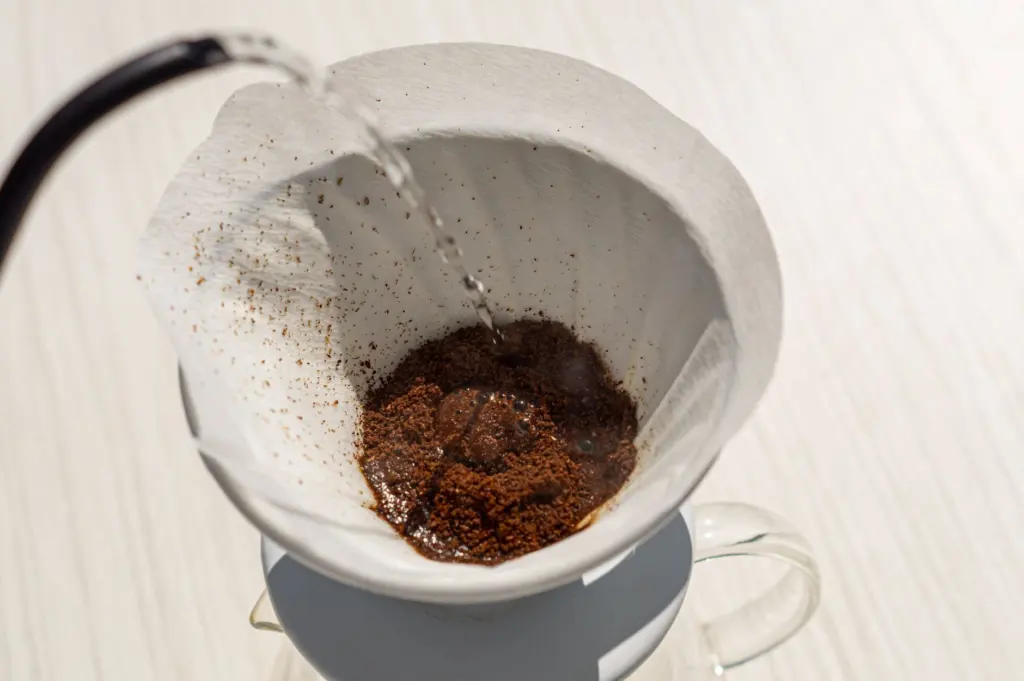
Brewer-specific timing is your reference. A Kalita Wave brew that lands within 2:30 to 3:00 minutes for 15 g coffee and 240 g water is on target, and a V60 near two and a half minutes is in the expected range. If the time is right but the cup is not, adjust the grind in the direction the taste indicates, then check the time again.
Where to go next
If you are still choosing between methods, French Press Or Pour Over? How To Choose The Best Brew For Your Taste In 2026 – Greatnorthernbrewing compares them on taste and effort. Once the cup is dialled in, Quick Creamy Coffee Frappe Recipe: Make a Café-Style Frappé at Home (2026) – Greatnorthernbrewing shows a different way to use coffee at home.
Frequently asked questions
Does grind size change how strong the coffee is?
Yes. Fellow Products says you can adjust strength by controlling how much water you pour and how finely you grind, so strength is a combined result of volume and fineness.
What water temperature suits pour-over?
Door County Coffee suggests 195–205 °F. One V60 guide uses 93 °C, and a specialty café quotes 92 °C (198 °F). All three fall within the same narrow band.
Can a poorly fitting filter affect the cup?
Yes. Fellow Products warns that a generic filter that does not fit properly makes water channel unevenly, which can leave the coffee bitter or sour. Use the filter made for your brewer before you blame the grind.